Published on Oct 2026
Beyond the Dial: Watchmaking at ION Orchard
Beyond the Dial: Watchmaking at ION Orchard
Published on Oct 2026
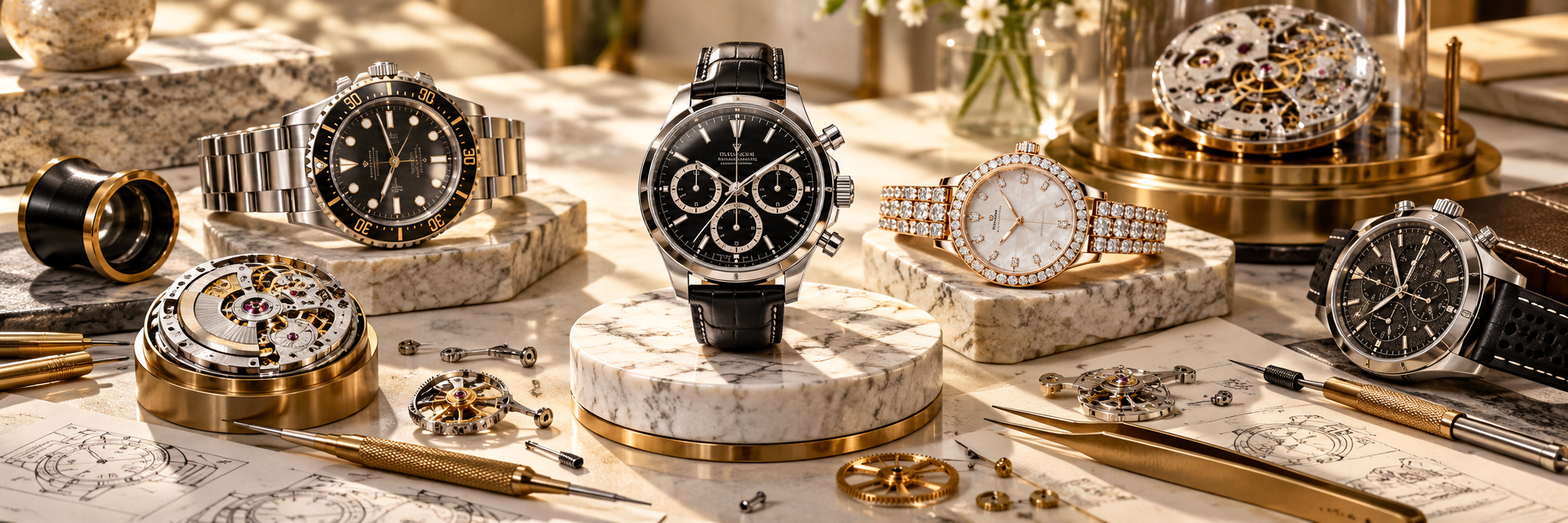
Most of the work that defines a mechanical watch goes unseen. A chronograph's extra hands reveal little of the mechanism beneath its dial, while the finishing of a movement may be visible only through the caseback. Understanding a watch often begins with looking at what its maker has chosen to conceal.
This October, A. Lange & Söhne's Challenging Chronographs exhibition brings that work into view at ION Orchard. The watch boutiques around it reveal other concerns, from the practical demands behind familiar designs to the details that determine how a watch sits on the wrist.
The Art of a Split Second
A. Lange & Söhne
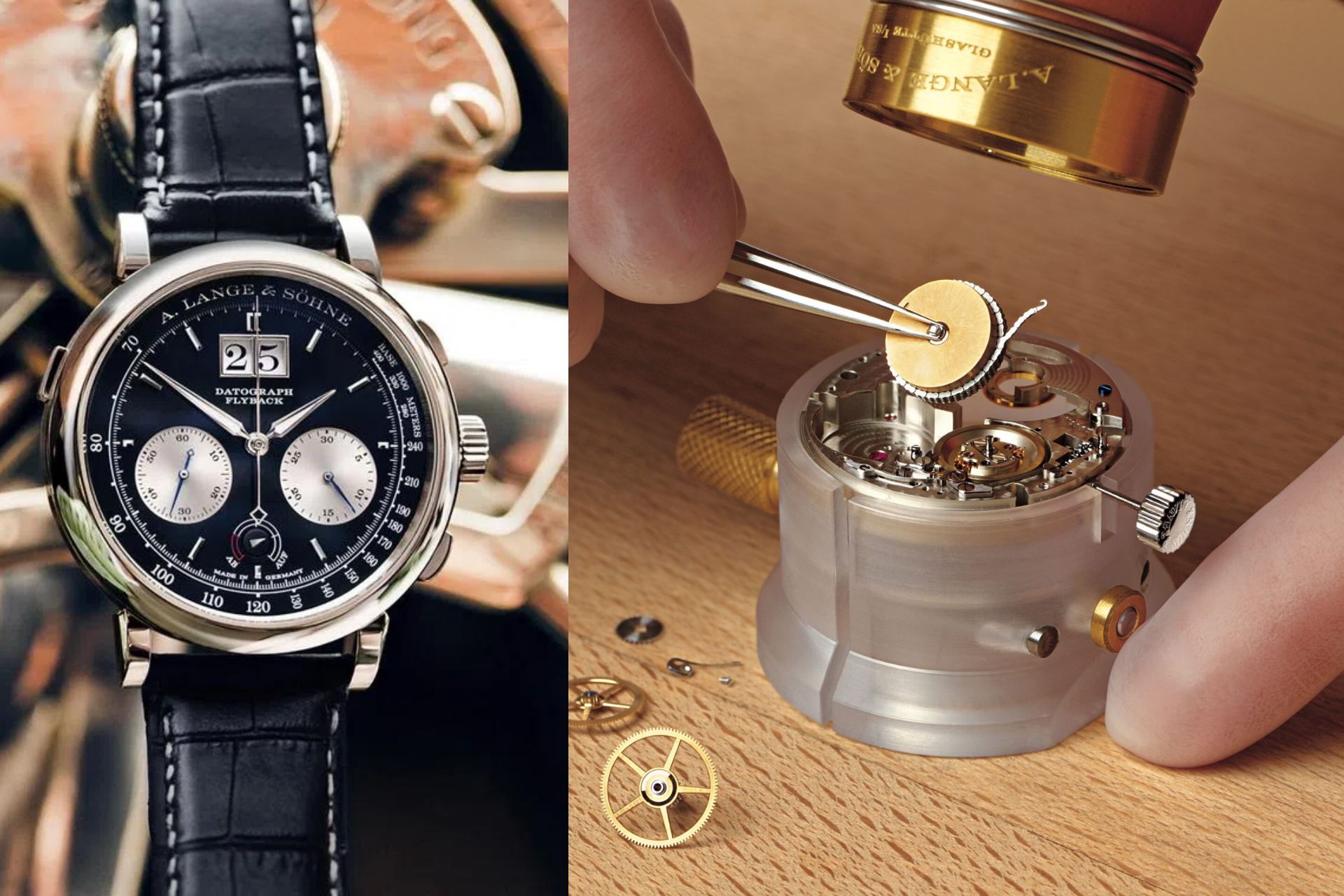
A chronograph functions as a stopwatch without interrupting a watch's usual timekeeping. A split-seconds chronograph goes further, using an additional hand to compare two events that begin together. It is a demanding complication, and one that A. Lange & Söhne has spent decades developing.
At the Level 1 Atrium from 18 to 30 October, Challenging Chronographs traces that progression from the DATOGRAPH, launched in 1999, to the DOUBLE SPLIT of 2004 and the TRIPLE SPLIT of 2018. The DOUBLE SPLIT allows two elapsed times to be compared over 30 minutes; the TRIPLE SPLIT extends the comparison to 12 hours. Each advance required another layer of mechanical ingenuity, contained within the limited space of a wristwatch case.
The exhibition also considers the manufacturer's association with classic motoring, including the Concorso d'Eleganza Villa d'Este. Most compelling are the demonstrations by a master watchmaker and a master engraver from Glashütte. The latter works freehand on a balance cock, a tiny component whose decoration demands an exceptionally steady hand.
Challenging Chronographs runs from 10am to 9pm daily. Guided tours and demonstrations are available by appointment.
A closer look at the craft, through spaces
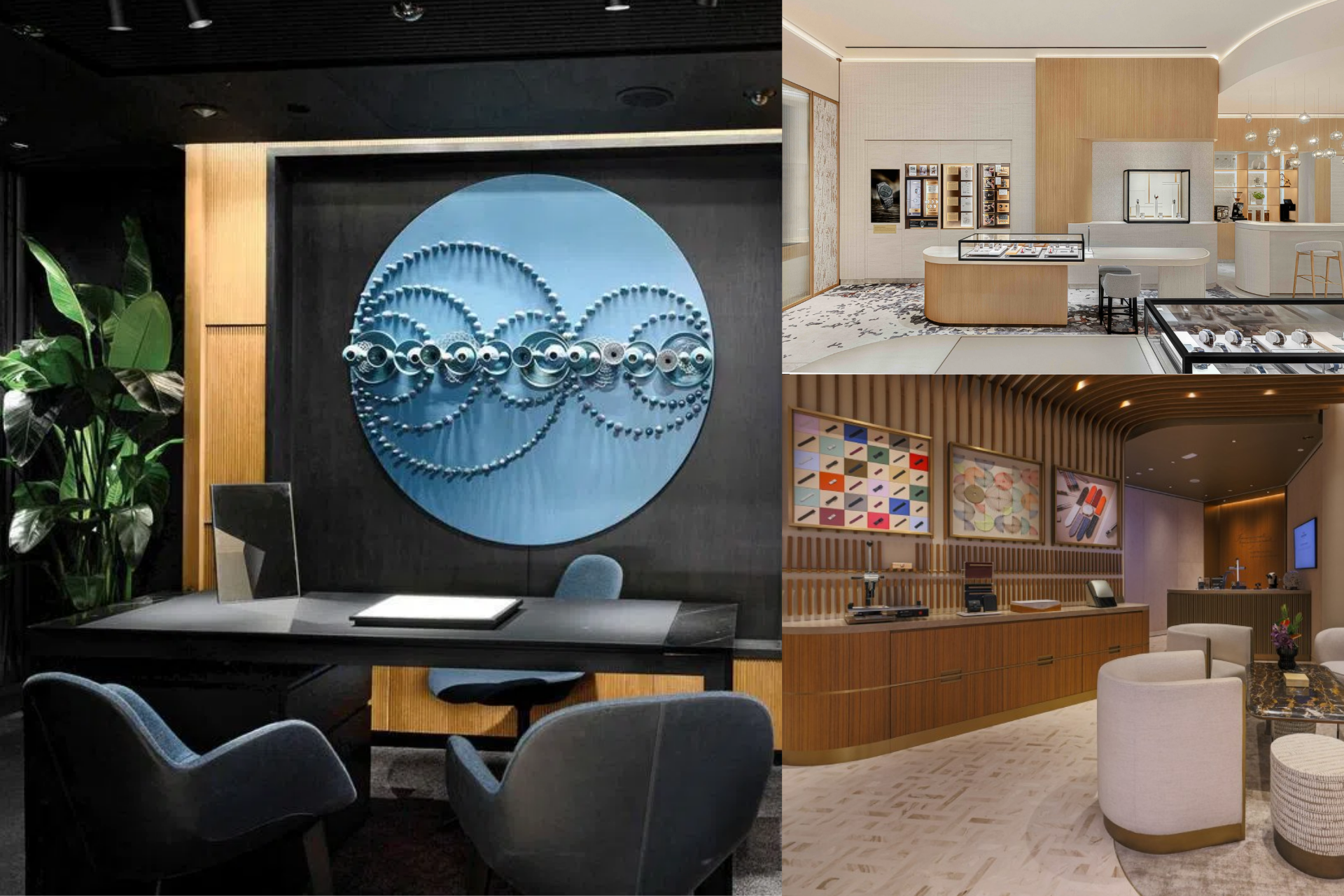
Clockwise: IWC Schaffhausen, Jaeger-LeCoultre, Vacheron Constantin
The work of a watchmaker is usually encountered only through the finished piece. Several ION Orchard boutiques offer a more direct view, with spaces dedicated to the mechanics, history and finishing of watches.
IWC Schaffhausen has set aside space for hands-on watchmaking classes in its new boutique, where the workings of complications such as perpetual calendars and moonphase displays can be examined. Another point of interest is an installation by Singaporean artist Kelly Jin Mei. Its more than 220 crocheted and ceramic elements follow a Fibonacci progression, echoing the repeating structures within a movement.
The new Jaeger-LeCoultre flagship draws on the manufacture's history of developing more than 1,400 calibres. Its Calibre Wall presents that technical breadth, while the Strap Bar looks at how a change of material or colour can alter the character of a watch. An Art Deco-inspired café references the era of the Reverso, introduced in 1931.
Vacheron Constantin's refurbished boutique puts finishing under scrutiny. Its Watchmaking Wall introduces processes such as polishing and chamfering, which are central to the standards of the Hallmark of Geneva. An in-house watchmaker can explain the work involved; nearby, the strap-personalisation area deals with more visible decisions about colour, material and stitching.
Designed to tell more than Time
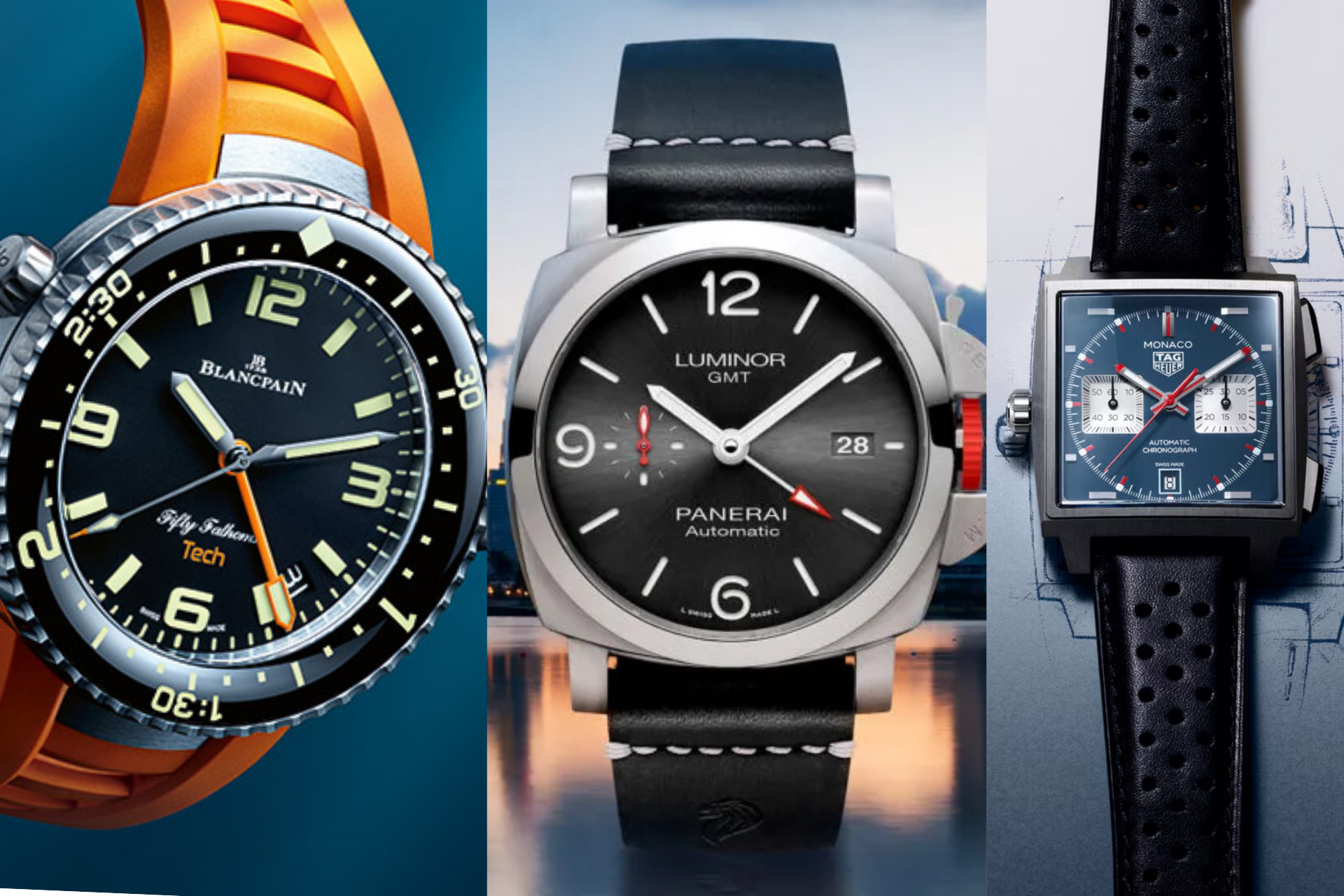
From left to right: Blancpain, Panerai, TAG Heuer
Many watches now regarded as design classics began as instruments. A diver needed to track minutes underwater; a naval watch had to remain legible in poor light; a racing chronograph had to be read quickly. The resulting features have outlasted those original demands.
Blancpain developed the Fifty Fathoms in 1953 for professional diving. Its luminous indications made the dial readable underwater, while a rotating bezel allowed divers to keep track of elapsed time. A patented locking system on the original watch helped prevent the bezel from being moved accidentally. The detail was dictated by safety, not appearance.
The naval origins of Panerai are equally apparent in the Luminor, from its luminous markings to the substantial crown-protecting bridge. The maison's redesigned ION Orchard boutique examines those choices through displays on water resistance, luminescence, power reserve and construction. Its recent Luminor 8 Giorni and 31 Giorni models continue the focus on extended running times.
For TAG Heuer, the demands came from motorsport. The Carrera of 1963 was developed with an uncluttered dial suited to reading elapsed time at speed. The Monaco, introduced in 1969, made an altogether different visual statement with its square case and automatic chronograph movement. Neither needs a racetrack today, but both still carry their original priorities in their design.
Time as part of your personal style
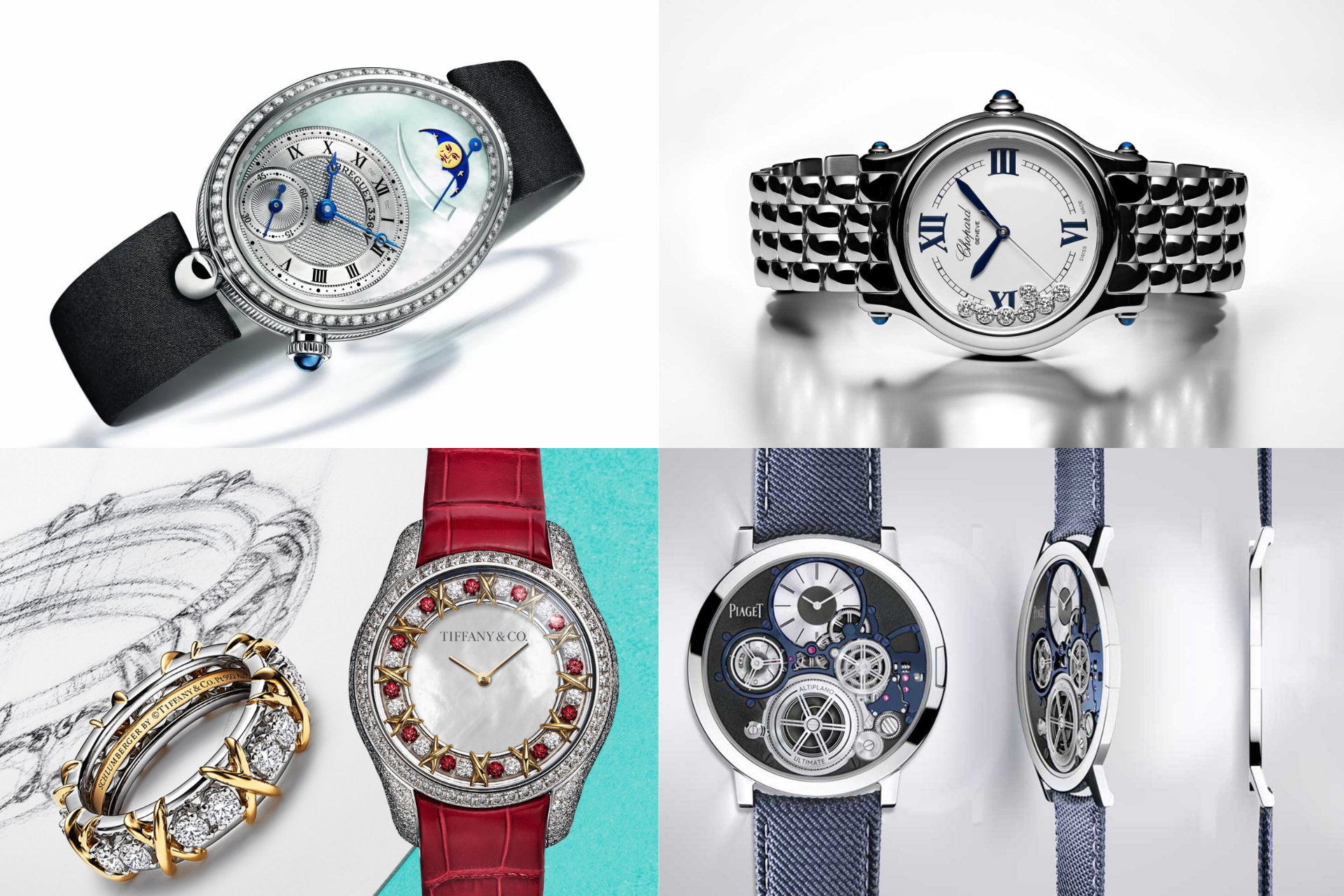
Clockwise: Breguet, Chopard, Piaget, Tiffany & Co.
The practical origins of a watch explain only part of its design. Case shapes, proportions and jewellery details have their own histories, and they often matter more to the person wearing the piece than an additional complication.
Breguet's Reine de Naples is distinguished by its elongated oval case, inspired by a watch commissioned in 1810 by Caroline Murat, Queen of Naples. The oval silhouette gives the dial a different balance and allows for an ornamental treatment closer to jewellery than a conventional round watch.
Chopard brought a different idea to women's watches with the Happy Sport in 1993, pairing steel with diamonds that move freely between two sapphire crystals. The diamonds shift as the wearer moves, turning a familiar piece of jewellery design into part of the watch itself.
At Piaget, the Altiplano and Polo show how different proportions can define a watch's personality. Ultra-thin watchmaking gives the Altiplano its slim, restrained profile; the Polo takes a sportier direction, with a cushion-shaped dial within a rounded case. Both can be explored at the maison's Radiance flagship, which also features displays devoted to high watchmaking and decorative techniques.
Tiffany & Co. approaches the wrist from a jeweller's perspective. Its expanded three-storey flagship includes Singapore's first dedicated Tiffany watch salon, where creations such as the Sixteen Stone Mother-of-Pearl Ruby watch adapt a familiar jewellery motif to a timepiece. Its proportions and stones invite the same attention as a ring or bracelet, with the added consideration of how the piece feels on the wrist.
What draws someone to a watch may begin with its movement, its history or simply the way it looks on the wrist. Often, the appreciation deepens with an understanding of the decisions behind its design, from the smallest mechanical detail to the proportions that give a timepiece its character.
Designed to tell more than Time
From left to right: Blancpain, Panerai, TAG Heuer
Many watches now regarded as design classics began as instruments. A diver needed to track minutes underwater; a naval watch had to remain legible in poor light; a racing chronograph had to be read quickly. The resulting features have outlasted those original demands.
Blancpain developed the Fifty Fathoms in 1953 for professional diving. Its luminous indications made the dial readable underwater, while a rotating bezel allowed divers to keep track of elapsed time. A patented locking system on the original watch helped prevent the bezel from being moved accidentally. The detail was dictated by safety, not appearance.
The naval origins of Panerai are equally apparent in the Luminor, from its luminous markings to the substantial crown-protecting bridge. The maison's redesigned ION Orchard boutique examines those choices through displays on water resistance, luminescence, power reserve and construction. Its recent Luminor 8 Giorni and 31 Giorni models continue the focus on extended running times.
For TAG Heuer, the demands came from motorsport. The Carrera of 1963 was developed with an uncluttered dial suited to reading elapsed time at speed. The Monaco, introduced in 1969, made an altogether different visual statement with its square case and automatic chronograph movement. Neither needs a racetrack today, but both still carry their original priorities in their design.
This October, A. Lange & Söhne's exhibition and ION Orchard's watchmaking boutiques offer an opportunity to explore these details firsthand, from the precision of a Glashütte engraver to the craftsmanship and design traditions of the world's leading maisons.
After all, the finer details of a watch are often the ones worth taking time to appreciate.
Explore these featured brands at ION Orchard:
A. Lange & Söhne – #02-04/05 and #03-01
Blancpain – #03-03
Breguet – #03-27
Chopard – #03-04
IWC Schaffhausen – #01-13A
Jaeger-LeCoultre – #01-18
Panerai – #01-13
Piaget – #03-02
TAG Heuer – #03-16
Tiffany & Co. – #01-21/26A and #02-11
Vacheron Constantin – #02-06
Photo Sources: A. Lange & Söhne, Blancpain, Breguet, Chopard, IWC Schaffhausen, Jaeger-LeCoultre, Panerai, Piaget, TAG Heuer, Tiffany & Co., Vacheron Constantin, ION Orchard.
Visitor
Corporate

COPYRIGHT © ION ORCHARD 2026
Orchard Turn Retail Investment Pte Ltd. A joint venture company between CapitaLand & Sun Hung Kai Properties.
CONTACT US
2 Orchard Turn, Singapore 238801
Opens daily from 10am - 10pm
Visitor
Corporate
LEGAL TERMS & CONDITIONS
COPYRIGHT © ION ORCHARD 2026
Orchard Turn Retail Investment Pte Ltd. A joint venture company between CapitaLand & Sun Hung Kai Properties.